

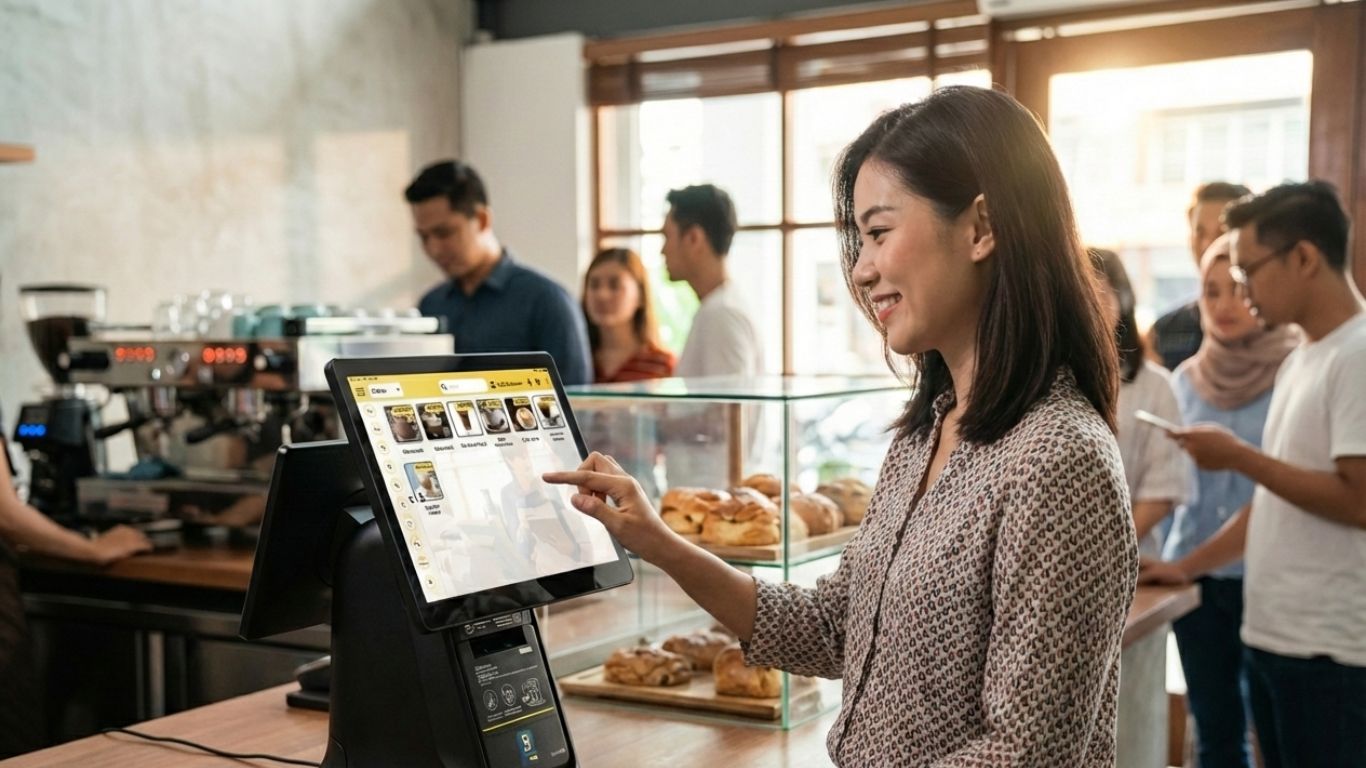
Franchise POS Management: Malaysian Brand Expansion Strategies
Key Takeaway:
Malaysian franchisors achieve scalable growth by deploying centralized, flexible POS systems, forging strategic government and financial partnerships, and executing market-driven expansion tactics tailored to local and regional consumer preferences.
Introduction
Franchising underpins a significant portion of Malaysia’s retail and food & beverage (F&B) sectors. In 2022, the industry contributed RM 30 billion to GDP through 1,197 registered franchise brands, 713 of which originated domestically. As homegrown franchisors ambitiously expand across ASEAN and beyond, effective Point-of-Sale (POS) management has emerged as the linchpin for operational consistency, brand integrity, and data-driven decision-making. This article delves into the critical role POS systems play in franchise operations and outlines comprehensive strategies for Malaysian brands to scale successfully.[1]
The Role of POS in Franchise Operations
A robust franchise POS system transcends basic transaction processing to become an operational nerve center. Leading platforms deliver:
- Centralized Multi-Location Management
Cloud-based dashboards aggregate real-time sales, inventory, and customer data across dozens or hundreds of outlets. Franchisors benefit from:[2]- Instant Visibility: Automated alerts for stockouts and demand spikes, enabling dynamic reallocation of inventory, minimizing lost sales, and maximizing revenue retention.[2]
- Consistent Pricing & Promotions: Synchronous rollout of price adjustments, menu launches, and loyalty campaigns across all units, preserving brand cohesion.[3]
- Advanced Inventory & Supply Chain Control
Automated replenishment at preconfigured thresholds eliminates manual purchase orders and human error. Batch and lot tracking ensure regulatory compliance—especially vital for F&B franchises subject to food safety audits and recalls. [3] - Integrated Reporting & Business Intelligence
Custom dashboards deliver insights into sales trends, margin performance, and SKU effectiveness. Drill-down analytics by store, region, or category empower franchisors to tailor marketing and operations for peak profitability.[4][3] - Omnichannel & Loyalty Integration
Unified customer profiles link in-store, online, and mobile interactions, enabling segmented targeting and personalized offers across all touchpoints. Native or API-driven integrations with delivery platforms streamline order fulfillment and enhance customer satisfaction.[5][3] - Franchisee Compliance & Standardization
Embedded SOP prompts guide staff through portion control, upselling, and hygiene protocols, safeguarding service quality and brand standards. Real-time royalty and marketing fund calculations simplify financial reconciliation and transparency between franchisor and franchisee.[3][2] - Scalability & Flexibility
Modular architectures allow seamless addition of modules—such as table management or appointment bookings—without disrupting core operations. Offline mode with local data caching ensures uninterrupted service in connectivity-challenged locations, synchronizing once network access is restored.[5] - Enhanced Security & Compliance
PCI DSS–compliant encryption and tokenization protect cardholder data, reducing breach risk and audit scope. Role-based access controls mitigate internal fraud by restricting system functions based on user roles.[4][3]
By centralizing control while preserving local adaptability, franchise-grade POS systems become a force multiplier—standardizing customer experiences, optimizing resource utilization, and equipping franchisors with actionable intelligence essential for rapid scaling.
Strategic Expansion Framework
Domestic Platform: FIM 2025
The Franchise International Malaysia 2025 (FIM 2025) expo convened over 150 franchise brands and 30,000 attendees, featuring ASEAN-focused sessions on digital transformation and business matching with investors from 20+ countries. FIM’s role as a domestic launchpad accelerates partnerships, capital-raising, and exposure to tech innovations—particularly franchisor-recommended POS solutions.[5]
Government & Financial Partnerships
Malaysian franchises leverage state-led financing schemes—Perbadanan Nasional, SME Bank, and Tekun Nasional—as well as MATRADE’s Market Development Grant to underwrite expansion costs. Empirical research shows government support significantly enhances franchisees’ survival (β = 0.302, p < 0.001; f² = 0.073). Such collaborations lower capital barriers, enabling investment in advanced POS infrastructure and digital training.[1]
International Trade Missions
Organized delegations to ASEAN neighbors (Indonesia, the Philippines, Taiwan) and emerging markets (Saudi Arabia, Kazakhstan) facilitate market intelligence gathering, regulatory navigation, and local partnerships. Inclusion of POS vendors and tech consultants in these missions ensures franchisors adopt systems aligned with target-market payment preferences and compliance requirements.[5]
Market Orientation as a Growth Driver
A strong Market Orientation (MO) culture—prioritizing customer insights, competitor analysis, and inter-departmental coordination—correlates positively with franchise resilience (β = 0.283, p < 0.001; f² = 0.17). MO empowers:[1]
- Agile Menu Customization: Rapid A/B testing of new products and promotions via POS-driven analytics.
- Localized Campaigns: Region-specific discount events synced through central POS schedules.
- Cross-Unit Collaboration: Shared best practices among franchisees via POS-enabled performance benchmarking.
Franchisor Support: Training & Governance
Ongoing franchisor support in training, SOP development, and governance underpins POS efficacy. Quantitative analysis confirms support quality influences survival (β = 0.169, p < 0.01; f² = 0.022). Best practices include:[1]
- Structured Onboarding: Interactive SOP manuals, video tutorials, and certification tracks ensure franchisee competency.
- Dedicated Helpdesk: 24/7 technical support with POS vendor liaisons for rapid issue resolution.
- Feedback Loops: Monthly performance reviews and feature-request forums drive iterative POS enhancements.
Implementation Roadmap
- Needs Assessment: Conduct a thorough audit of inventory flows, transaction volumes, and channel touchpoints.
- Platform Selection: Prioritize cloud-hosted, modular systems with offline resilience and rich APIs.
- SOP & Training Development: Craft digital SOP repositories and hybrid learning curriculums backed by video and gamified assessments.
- Support Infrastructure: Establish a tiered helpdesk—resolving frontline issues swiftly and escalating complex cases to vendor specialists.
- Funding & Grants: Leverage SME Bank financing and MSME grants to subsidize POS hardware and software costs.
- Trade Mission Engagement: Coordinate with MFA and industry associations to include POS integration workshops in trade delegations.
- Continuous Optimization: Utilize centralized dashboards to monitor KPIs—such as average transaction value and table turnover—and iterate on pricing, promotions, and menu engineering.
Conclusion
Franchise expansion in Malaysia hinges on the seamless integration of advanced POS systems, robust franchisor support structures, and market-aligned growth strategies. By centralizing data and processes while enabling local adaptability, franchisors can maintain brand consistency, empower franchisees, and harness actionable insights for rapid scaling. Strategic collaborations—with government bodies, financial institutions, and regional partners—further amplify franchisors’ capacity to invest in cutting-edge POS technologies and training programs. Equipped with these frameworks, Malaysian brands are well-positioned to capture ASEAN market share and forge enduring global footprints.
Success for Malaysian franchises lies at the intersection of local adaptability and centralized control—a balance perfected by BIGPOS. Our advanced POS system serves as the bridge between franchisor vision and franchisee execution, turning raw data into a roadmap for rapid expansion. By integrating BIGPOS into their growth strategy, Malaysian brands are better equipped to navigate local regulatory landscapes, leverage strategic financial partnerships, and ultimately capture their share of the global market.
- https://e-journal.uum.edu.my/index.php/gbmr/article/download/26902/4840/98418
- https://limerrs.com/8-must-have-features-of-an-ideal-franchise-pos-system-2/
- https://thefranchisecto.com/a-comprehensive-guide-to-the-best-pos-systems-for-franchises/
- https://www.franchisewire.com/the-complete-guide-to-pos-for-franchises/
- https://www.mfa.org.my/franchise-international-malaysia-2025-fim-2025-a-strategic-gateway-for-asean-franchise-expansion/